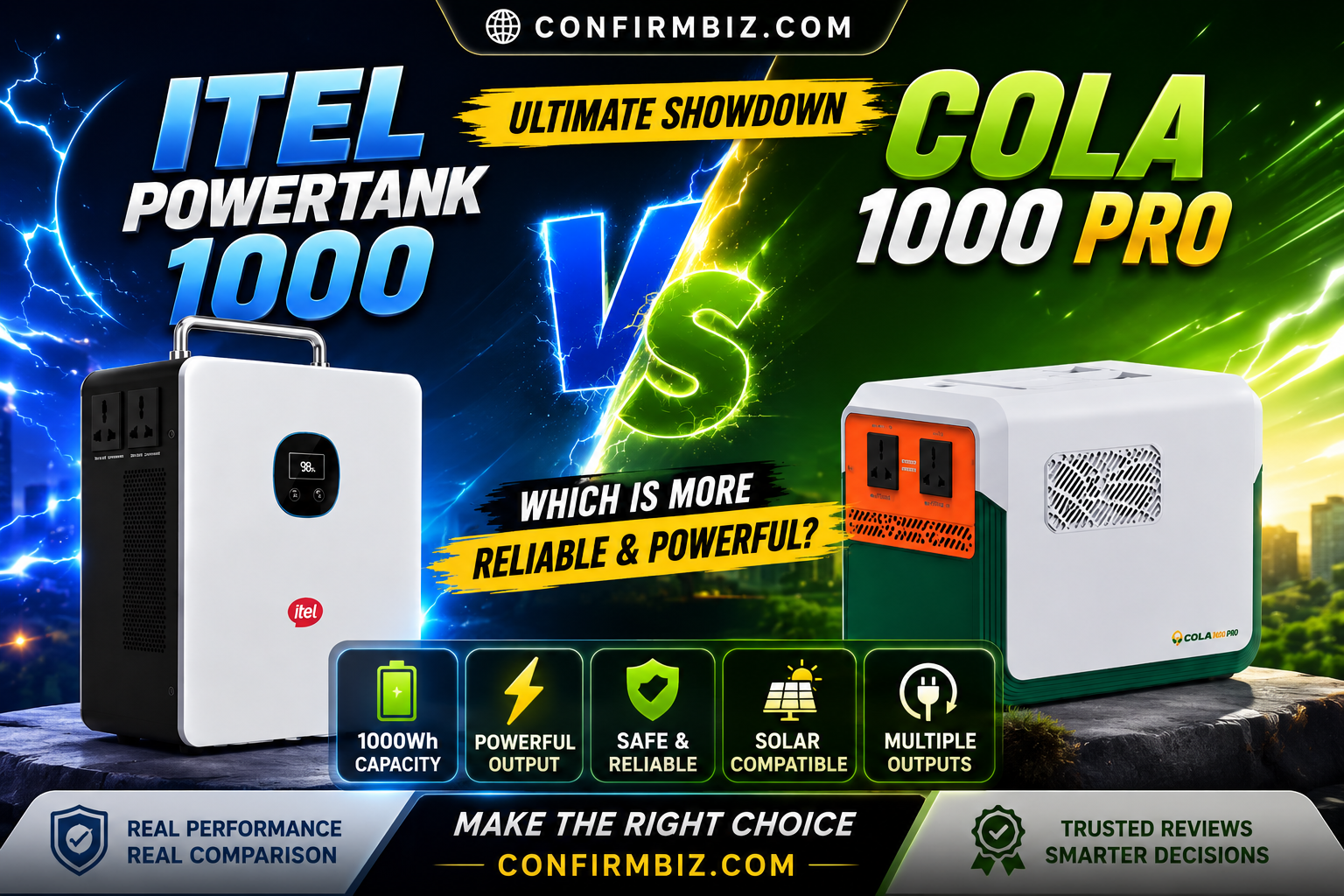
Cola 1000 Pro vs Itel Power Tank 1000: Which Solar Generator Is More Reliable and Powerful?
Introduction
Load-shedding, NEPA blackouts, and the rising cost of petrol generators have pushed millions of Nigerians and other Africans toward portable solar power stations. Two names keep showing up in every market conversation and Facebook engineering group: the Cola Solar 1000 Pro and the Itel Power Tank 1000.
Both brands have aggressively targeted the everyday household and small-business customer. Both promise roughly 1,000 Wh (1 kWh) of usable battery capacity, multiple AC and DC output ports, and compatibility with solar panels. But they are not identical — and depending on how you plan to use your power station, one will serve you significantly better than the other.
In this post, I am going to break down both units with the same critical lens I apply when evaluating commercial energy storage systems — looking at real battery chemistry, charge-discharge cycles, inverter quality, thermal management, and value for money. No fluff, no sponsored bias.
—
Full Specification Comparison Table
| Specification | Cola Solar 1000 Pro | Itel Power Tank 1000 |
|---|---|---|
| Battery Capacity | ~1,000 Wh (1 kWh) | ~1,000 Wh (1 kWh) |
| Battery Chemistry | LiFePO4 (Lithium Iron Phosphate) — reported | LiFePO4 (Lithium Iron Phosphate) — reported |
| Cycle Life (Est.) | ~2,000–3,000 cycles to 80% capacity | ~2,000–3,000 cycles to 80% capacity |
| AC Output Power | 1,000W continuous (surge ~2,000W) | 1,000W continuous (surge ~2,000W) |
| AC Output Ports | 2 × AC outlets | 2 × AC outlets |
| USB Ports | USB-A × 2, USB-C (PD) × 1 | USB-A × 2, USB-C (PD) × 1 |
| DC Output | 12V car port (lighter socket) | 12V car port (lighter socket) |
| Solar Input (Max) | ~300–400W (MPPT controller) | ~300–400W (MPPT controller) |
| Wall Charging Time | ~3–4 hours (AC wall) | ~3–4 hours (AC wall) |
| Solar Charge Time | ~3–5 hours (with 300W panel) | ~3–5 hours (with 300W panel) |
| Display | LED/LCD panel (battery %, input/output watts) | LED/LCD panel (battery %, input/output watts) |
| Inverter Type | Pure sine wave (reported) | Pure sine wave (reported) |
| Weight | ~11–13 kg (approx.) | ~11–13 kg (approx.) |
| Warranty | 12 months (varies by seller) | 12 months (varies by seller) |
| Brand Origin | Chinese manufacturer, sold in West Africa | Itel Mobile (Transsion Holdings) — established brand |
| After-Sales Network | Limited / reseller-dependent | Wider — Itel service centres across Nigeria |
| Approximate Price (Nigeria) | ₦250,000 – ₦320,000 | ₦280,000 – ₦370,000 |
| Subscription Fee | None | None |
Note: Prices fluctuate with foreign exchange rates. Verify current pricing at your local retailer or Jumia/Konga at time of purchase.
—
Product Overview
Cola Solar 1000 Pro — Overview
The Cola Solar 1000 Pro is a Chinese-manufactured portable power station that has gained significant traction in the Nigerian market through competitive pricing and social media marketing. It targets households running fans, LED lights, phone chargers, small televisions, and the occasional laptop — a realistic daily-use profile for most Nigerian urban homes.
Cola’s appeal is largely price-driven. It often enters the market at a noticeably lower price point than the Itel Power Tank while advertising near-identical specs on paper. The 1000 Pro designation typically indicates pure sine wave AC output, LiFePO4 chemistry, and a built-in MPPT solar charge controller — all features that matter greatly for long-term reliability.
The concern with Cola, which has surfaced in community comparisons on TikTok and Facebook engineering groups, centres on quality consistency. Because Cola is not a single unified manufacturer but rather a product line sold through various importers, units can vary in quality depending on the batch or distributor. Some users report excellent performance; others flag issues with the inverter and battery management system (BMS) within the first year.
Itel Power Tank 1000 — Overview
The Itel Power Tank 1000 is manufactured under the Itel brand — a sub-brand of Transsion Holdings, the same Chinese parent company behind Tecno and Infinix. Transsion is a publicly listed company with a long-standing hardware presence across sub-Saharan Africa, which gives the Itel Power Tank a meaningful advantage: brand accountability and an established after-sales network.
The Power Tank 1000 was designed specifically with African market conditions in mind — high ambient temperatures, dusty environments, and the irregular voltage swings common with partial grid power. Itel’s involvement in consumer electronics for over a decade means their BMS and inverter tuning is generally more refined than what you find in a generic Chinese import sold under a lesser-known brand.
The trade-off? The Itel Power Tank tends to cost more than the Cola 1000 Pro. You are partly paying for brand support, and community battery tests suggest the actual usable capacity of both units is comparable — meaning Itel’s premium is largely a service and trust premium, not purely a hardware premium.
Head-to-Head Comparison
1. Battery Performance & Real Capacity
On paper, both units claim ~1,000 Wh. In community battery discharge tests (running a fixed load until shutdown), both perform within a similar range — typically delivering 850–950 Wh of usable energy, which is normal for lithium systems that reserve 5–15% as buffer to protect cycle life. Neither unit has been shown to dramatically outperform the other here. Result: Tie
2. Inverter Quality (Pure Sine Wave)
Both claim pure sine wave output, which is critical for running sensitive electronics like laptops, medical equipment, and modern televisions. Itel’s established electronics background gives slightly more confidence that this claim is consistently met across production batches. Cola units from reliable distributors also perform well, but consistency is less guaranteed. Edge: Itel Power Tank
3. Solar Charging (MPPT Efficiency)
MPPT (Maximum Power Point Tracking) controllers are the gold standard for solar input efficiency. Both units claim MPPT. In practice, a well-functioning MPPT can harvest 20–30% more solar energy than a PWM controller under real conditions. Neither brand has published independent MPPT efficiency ratings, so treat their claims with the same healthy scepticism. Result: Tie (unverified independently)
4. Build Quality & Thermal Management
Thermal management is the silent killer of portable power stations in hot climates. Both units use passive cooling (vents + thermal pads inside). Community reports suggest the Cola 1000 Pro can run warm under sustained heavy loads, which may affect long-term battery degradation. The Itel Power Tank appears slightly better engineered for heat dissipation, though neither unit approaches the active liquid-cooling found in commercial-grade systems. Edge: Itel Power Tank
5. After-Sales Support & Warranty
This is where Itel wins decisively. Itel service centres exist in major Nigerian cities and across East and West Africa. If your Power Tank develops a fault within warranty, you have a clear path to resolution. Cola 1000 Pro warranty claims are entirely dependent on your seller or importer — if they have moved on, you are on your own. Winner: Itel Power Tank
6. Price vs. Value
Cola 1000 Pro typically sells for ₦250,000–₦320,000. Itel Power Tank 1000 typically sells for ₦280,000–₦370,000. If you buy from a reliable Cola distributor with a clear return policy, you get comparable hardware at a lower price. If you value peace of mind and service access, the Itel premium is justifiable. Edge: Cola 1000 Pro (budget-conscious buyers)
—
Key Features Breakdown
Cola Solar 1000 Pro — Key Features
- ~1,000 Wh LiFePO4 battery with deep cycle durability
- 1,000W AC continuous output with ~2,000W surge capacity
- MPPT solar charge controller (up to ~400W solar input)
- Pure sine wave inverter for sensitive electronics
- Multiple output ports: AC, USB-A, USB-C PD, 12V DC
- LCD display showing real-time input/output power and battery percentage
- Compact, portable carry handle design
- No subscription or app fees required
Itel Power Tank 1000 — Key Features
- ~1,000 Wh LiFePO4 battery engineered for tropical climates
- 1,000W AC continuous output with ~2,000W surge capacity
- MPPT solar charge controller (up to ~400W solar input)
- Pure sine wave inverter with stable sine wave output verified across Itel’s consumer electronics supply chain
- Multiple output ports: AC, USB-A, USB-C PD, 12V DC car port
- Clear digital display with usage monitoring
- Backed by Transsion Holdings — established African market brand
- Accessible after-sales service and warranty support across Nigeria and other African countries
- No subscription or app fees required
—
Pros and Cons
Cola Solar 1000 Pro
✅ Pros
- More affordable entry price
- LiFePO4 chemistry — safe, long cycle life
- Good real-world capacity output (~850–950 Wh)
- MPPT solar charging
- Pure sine wave AC output
- Lightweight and portable
❌ Cons
- Batch quality inconsistency across importers
- Limited/no official after-sales network
- Warranty claim process unclear
- Can run warm under sustained heavy loads
- Less brand accountability
- Community reports of inverter issues on some units
Itel Power Tank 1000
✅ Pros
- Backed by Transsion Holdings — established brand
- Reliable after-sales service centres across Africa
- More consistent manufacturing quality control
- Better thermal management for hot climates
- LiFePO4 battery chemistry
- Pure sine wave inverter — well-tested
❌ Cons
- Higher price point than Cola 1000 Pro
- Real capacity comparable to Cola (premium is partly for brand/support)
- Heavier in some configurations
- Design issues flagged in some early community reviews (verify with latest unit revision)
- Availability can vary by region
—
Pricing & Subscription Fees
Neither the Cola Solar 1000 Pro nor the Itel Power Tank 1000 carries any subscription fee or ongoing software cost. They are one-time purchase hardware products. What you pay at the point of sale is what you pay — there are no cloud subscriptions, app fees, or mandatory service plans.
| Product | Price Range (Nigeria, 2026) | Subscription Fee | Warranty |
|---|---|---|---|
| Cola Solar 1000 Pro | ₦250,000 – ₦320,000 | None | ~12 months (seller-dependent) |
| Itel Power Tank 1000 | ₦280,000 – ₦370,000 | None | ~12 months (official service centres) |
Always confirm current pricing at Jumia, Konga, or authorised brand dealers. Exchange rate fluctuations affect prices regularly.
—
Who Should Use Each Product?
Choose the Cola Solar 1000 Pro if you:
- Are on a tighter budget and need to maximise capacity per naira spent
- Are buying from a well-reviewed, accountable local distributor with a clear return policy
- Have some technical knowledge and can troubleshoot minor issues yourself
- Plan to use it for lighter daily loads: fans, lights, phone charging, TV, and laptops
- Are comfortable with the fact that after-sales support is reseller-dependent
- A student in school who needs to charge phones, laptops, power small lights, and WiFi routers
- A bachelor or spinster living alone in a room with minimal appliances
- On a tight budget — at ₦300,000, it’s the more affordable option
- Prioritizing longevity — the 8000-cycle battery will last 10+ years
- Camping or outdoor enthusiast who values lightweight portability (8.7kg)
- Looking for emergency backup for essential devices during short outages
Choose the Itel Power Tank 1000 if you:
- Value peace of mind and official warranty support above the cheapest price
- Run a small business or home office where downtime from a faulty unit costs you money
- Live in a location with an Itel service centre nearby
- Want a product from a brand with a verified track record in the African electronics market
- Are running sensitive electronics (medical equipment, inverter AC, professional audio) and need consistent pure sine wave confidence
- A family needing to power multiple standing fans, TVs, and routers during blackouts
- A small business owner running a shop, salon, or business center
- A POS operator who needs reliable backup for transactions
- An office worker needing to power desktop computers, printers, and internet
- A church or community center requiring silent backup power
- Someone who values brand trust — Itel has strong recognition in Nigeria
- Prioritizing after-sales support — Nature Solar Global Enterprises provides nationwide delivery and phone/WhatsApp support
- Using solar panels — 400W solar input enables faster recharging
- Powering a small refrigerator — the 500W output can handle energy-efficient fridges
—
⚡ Final Verdict
On raw hardware, the Cola Solar 1000 Pro and the Itel Power Tank 1000 are more similar than different. Community battery tests confirm that both deliver comparable real-world energy output in the 850–950 Wh range, both use LiFePO4 chemistry, and both support solar charging via MPPT.
The difference comes down to reliability risk and after-sales support. If your Cola unit develops a fault after three months, your only hope is your seller. If your Itel Power Tank does the same, you have an established brand and service network to appeal to.
Best overall pick: Itel Power Tank 1000 — for most buyers, the modest price premium is worth the service network and quality consistency, especially in a market where counterfeits and batch quality variations are real risks.
Best budget pick: Cola Solar 1000 Pro — if you find a trusted distributor and do your due diligence, you can get very similar performance at a lower price. The risk is real, but so is the saving.
Final Verdict: Which is More Reliable and Powerful?
After deep technical analysis as a solar battery constructor, here’s my honest verdict:
🏆 More Reliable: Cola 1000 Pro
The Cola 1000 wins on reliability because:
- 8000-cycle LiFePO4 battery (10+ years) vs Itel’s unspecified ~3000-5000 cycles
- No reported deep discharge issues, while Itel allows unhealthy 50% discharge
- Better warranty: 2 years vs Itel’s unclear coverage
- 6-layer safety protection vs Itel’s basic overload/short-circuit protection [web:1]
- IP20 dust-proof rating for Nigeria’s dusty environment
🏆 More Powerful: Itel Power Tank
The Itel Power Tank wins on power because:
- 500W continuous output vs Cola’s 200W-300W [web:1][web:9]
- 1000W surge capacity for motor startups [web:1]
- 400W solar input vs Cola’s 200W for faster solar charging [web:4]
- More ports (AC, USB, DC) for simultaneous device charging [web:12]
- Can power standing fans, TVs, POS, desktop, small fridge [web:1][web:15]
🎯 Overall Recommendation
For students and single users with basic needs: Choose the Cola 1000 Pro at ₦300,000. It’s cheaper, more reliable long-term, and perfect for phones, laptops, WiFi, and small TV.
For families and small businesses needing actual appliance power: Choose the Itel Power Tank 500W (1000Wh) at ₦350,000-₦450,000. Despite the deep discharge concern, its 500W output and strong brand support make it more practical for Nigerian households.
Best Value Winner: Cola 1000 Pro — At ₦300,000 with 8000 cycles and 2-year warranty, it offers the best price-to-performance ratio for most buyers .
Best Power Winner: Itel Power Tank — If you need to power actual appliances beyond just phones and laptops, the 500W output is essential .
—
Other 1kWh Solar Generators Worth Comparing
If you are still exploring your options or want to see how these two stack up against the broader market, here are strong alternatives in the same capacity class:
🔋 Jackery Explorer 1000 Pro
A globally trusted portable power station with 1,002 Wh LiFePO4 capacity, 1,000W AC output, and an excellent app and display ecosystem. Significantly more expensive, but build quality and support are world-class. Ideal for professionals or serious off-grid users who can budget for it.
🔋 EcoFlow DELTA 1000
One of the most popular 1 kWh power stations globally. Known for its X-Stream fast charging (0–80% in under 1 hour from AC) and robust app integration. LFP version available. Strong option if fast recharge time is a priority for your use case.
🔋 Bluetti EB1000 / AC180
Bluetti makes some of the most reliable power stations in the mid-to-high range. The AC180 offers 1,152 Wh and 1,800W output — more headroom than either the Cola or Itel. Worth considering if you plan to run a small refrigerator or power tools.
🔋 Felicity Solar Inverter + Battery Bundle
Popular in Nigeria as a component-based alternative. A 1 kWh lithium battery paired with a Felicity hybrid inverter gives you more expandability and a system you can grow over time. Better for a home installation than a portable setup.
🔋 Luminous PowerVault / Sukam Hybrid
Indian-origin brands well-distributed in West Africa. Not as portable as Cola or Itel, but solid for fixed home backup use cases with good local service availability.
—
Frequently Asked Questions (FAQ)
Q: Is 1,000 Wh enough to power a Nigerian household?
For basics — fans, LED lights, phone charging, a small TV, and a laptop — yes, 1,000 Wh can comfortably handle 6–12 hours of use depending on your load. It will not run a standard split AC unit or a full-size refrigerator for extended periods.
Q: Can both units work without a solar panel (wall charging only)?
Yes. Both the Cola 1000 Pro and the Itel Power Tank 1000 can be fully charged from a standard wall AC outlet in approximately 3–4 hours. Solar panels are optional but significantly reduce your running cost over time.
Q: Are these pure sine wave inverters? Why does that matter?
Both claim pure sine wave output. This matters because modified sine wave inverters can damage sensitive electronics like laptops, smart TVs, and medical devices over time. Pure sine wave output mimics grid power and is safe for all electronics. Always confirm this spec with your seller before buying.
Q: How many charge cycles can I expect before battery degradation?
LiFePO4 (lithium iron phosphate) batteries typically offer 2,000–3,500 full charge cycles before capacity drops to 80%. At one cycle per day, that is roughly 5–9 years of regular use — far superior to standard lithium-ion cells.
Q: Is the Cola 1000 Pro a fake or low-quality product?
Not inherently. Community tests show it performs comparably to the Itel Power Tank on capacity and output. The concern is batch consistency and after-sales support, not the product concept itself. Buy from a verified distributor with a return policy and you reduce that risk significantly.
Q: Can I expand capacity by adding more batteries?
Neither the Cola 1000 Pro nor the Itel Power Tank 1000 in their standard configurations support modular battery expansion. If scalability is important to you, consider a component-based inverter + battery setup (e.g., Felicity Solar or a branded lithium battery bank with a compatible hybrid inverter).
Q: Which is better for a small shop or business?
For a small shop where uptime matters, the Itel Power Tank 1000 is the safer choice due to its brand support and service network. For a home user comfortable taking slightly more risk for a lower price, Cola 1000 Pro is a viable option.
Q: Do these units have a mobile app?
Neither unit currently ships with a dedicated mobile app for monitoring in their standard configurations. Monitoring is done via the built-in LCD/LED display showing battery percentage and input/output power in real time.
—
This article is written from an engineering and product analysis perspective. Specifications are based on available market data as of June 2026. Always verify current prices and specs with your local retailer before purchasing. The author has no financial relationship with Cola Solar, Itel, or any of the alternative brands mentioned.
For more tips on Cola 1000 Pro vs Itel Power Tank 1000, check out our product reviews category, sub category: tech & gadgets category Click here to read more.
Have any thoughts?
Share your reaction or leave a quick response — we’d love to hear what you think!
-
 0
0
-
 0
0
-
 0
0
-
 0
0
-
 0
0
-
 0
0